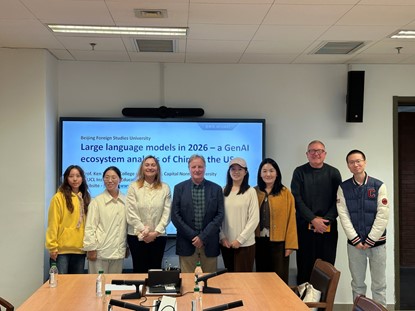
On the afternoon of November 4, the Learn-In: Education Matters series, hosted by the Graduate School of Education (GSE) at Beijing Foreign Studies University, was held in Room 953 of the International Building. Professor Ken Spours from the College of Education, at Capital Normal University, and the UCL Institute of Education, delivered the keynote lecture titled “Large Language Models in 2026: A GenAI Ecosystem Analysis of China and the US.” He analyzed the differences between China and the US generative AI ecosystems and their governance. The lecture was opened with a welcome address by the Dean of the GSE, Professor Yuan Dayong, who introduced Professor Ken Spours. The session was chaired by Associate Professor Jáfia Naftali Câmara. The event was supported by PhD students Cao Jing, Kang Mingyang, and Wang Xue.
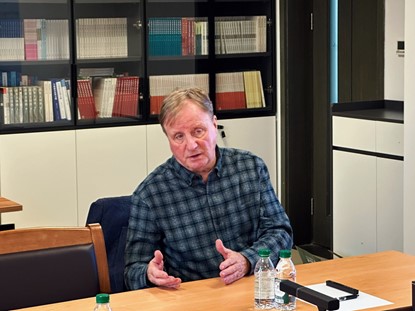
Professor Spours noted that China and the US share similar underlying technological structures, both driven by large technology companies. The two countries diverge at the strategic level. The US is led by venture capital, and public concern about uncontrolled AI has intensified. China pursues technological sovereignty through industrial policy, with a relatively high degree of social consensus. In terms of model performance, the US models lead in complex reasoning, while Chinese models have advantages in open-source ecosystems and cost control. The focus of global AI competition is shifting from single models to complete ecosystems, including infrastructure, models, frameworks, and applications. The pace of technological iteration exceeds institutions’ adaptation cycles.
The lecture then focused on the meso-level role in political economy. Universities and other mid-level institutions can translate macro policies and provide support for individuals. China embeds model systems in public infrastructure and manufacturing, giving it a diffusion advantage. Professor Spours proposed the concept of “Intelligent Intellect.” He argued that humans provide intentionality and reflection, while machines handle data processing. Universities should guide faculty and students to preserve “non-digital sanctuary time” and organize collaborative discussions to help them establish healthy human–machine relationships.
During the dialogue session, faculty and students discussed experiences with technology and educational practice. A student, drawing on their research experience, noted that model context windows have expanded and hallucinations have decreased, but generative AI still has limitations in logical critique and deep reasoning. Professor Mario Novelli, a visiting scholar from the University of Sussex, mentioned that UK universities are experiencing AI anxiety. Students rely on AI to generate essays, and teachers use AI to grade assignments. These practices have raised concerns about skill degradation and the effectiveness of regulation. In response to these concerns, Professor Spours suggested that universities avoid a purely defensive technical posture and establish regular collaborative reflection mechanisms through workshops and community discussions to help faculty and students clarify what materials to input to machines, how to scrutinize machine outputs, and how to maintain their agency in knowledge production.
After the lecture, participants took a group photo. The Learn-In series at the GSE will continue to invite scholars from China and abroad to promote in-depth dialogue between educational research and technological practice.